Paracetamol is one of the most commonly used medicines in South African homes. Whether it is kept in a bathroom cabinet in Johannesburg, packed in a travel bag for a December holiday, or bought from a local pharmacy for a headache, toothache, cold or fever, it is often seen as a simple everyday medicine. But “simple” does not mean “risk-free”.
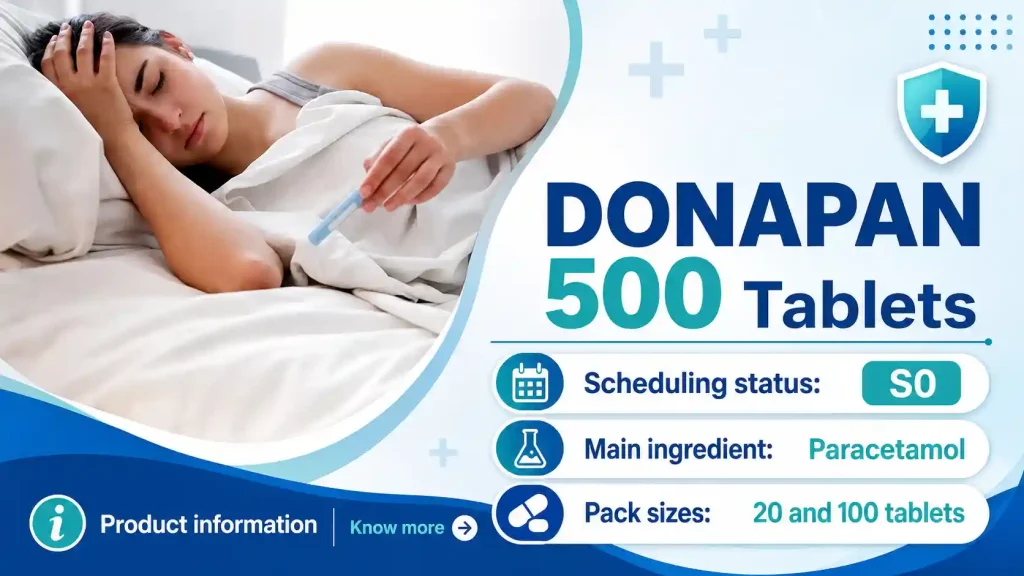
Donapan 500 mg tablets contain paracetamol, a medicine used for the relief of mild to moderate pain and fever. The professional information for Donapan explains how the medicine should be used, who should avoid it, which interactions matter, what side effects may occur, and why overdose must be treated as a medical emergency.
Quick overview of Donapan 500 mg
| Point | Details |
|---|---|
| Medicine name | Donapan 500 mg tablets |
| Active ingredient | Paracetamol 500 mg per tablet |
| Sugar content | Sugar free |
| Medicine form | Tablet |
| Appearance | White, round, flat, bevelled-edge tablet, plain on one side with a break line on the other |
| Main uses | Mild to moderate pain and fever |
| Examples of use | Headache, toothache, pain linked to colds and flu |
| How it is taken | By mouth, swallowed with liquid |
| Important warning | Do not exceed the recommended dose because overdose may cause severe liver damage and can be fatal |
| Children under 6 years | Not recommended |
| Storage | Store at or below 30 °C, protect from light and moisture, and keep in the original packaging |
What Donapan 500 mg is used for
Donapan 500 mg is used for the relief of mild to moderate pain and fever. This includes common day-to-day symptoms such as:
- Headaches
- Toothache
- Fever
- Pain associated with colds and flu
In a South African , many people use paracetamol when they feel “fluish”, have a temperature, or need pain relief that is generally gentle on the stomach compared with some anti-inflammatory medicines. However, it is still important to use it correctly and not to combine it carelessly with other products that may also contain paracetamol.
Many cold and flu mixtures, sachets and combination tablets may contain paracetamol. Taking Donapan together with those products can accidentally push a person above the safe daily limit.
What is inside Donapan 500 mg?
Each Donapan tablet contains 500 mg of paracetamol. The product is sugar free.
The listed excipients are:
| Ingredient type | Listed excipients |
|---|---|
| Non-active ingredients | Colloidal anhydrous silica, dioctyl sodium sulphosuccinate, magnesium stearate, maize starch, polyvinylpyrrolidone |
These excipients help with the structure, manufacturing and stability of the tablet. People with known allergies or sensitivities should always check the ingredients before using any medicine.
How Donapan 500 mg works
Paracetamol has analgesic and antipyretic activity. In plain language, this means it helps relieve pain and reduce fever.
| Medical term | Meaning |
|---|---|
| Analgesic | Helps reduce pain |
| Antipyretic | Helps lower fever |
Paracetamol is not mainly used as an anti-inflammatory medicine in the way that medicines such as ibuprofen or diclofenac are. Its main role is pain and fever relief.
Recommended dosage
The professional information gives different dosing instructions for children, older children and adults. The most important rule is simple: do not exceed the recommended dose.
| Age group | Recommended dose | Maximum in 24 hours |
|---|---|---|
| Children 6–12 years | ½ to 1 tablet every 6 hours | Not more than 4 doses in 24 hours |
| Children over 12 years | 1 tablet every 4–6 hours | Not more than 4 tablets in 24 hours |
| Adults | 1–2 tablets every 4–6 hours | Not more than 8 tablets in 24 hours |
| Children under 6 years | Not recommended | Not applicable |
For adults, the maximum listed amount is 8 tablets in 24 hours. Since each tablet contains 500 mg paracetamol, this equals 4 000 mg, or 4 g, of paracetamol per day.
That maximum should not be treated as a target. It is the upper limit. Use the lowest effective dose for the shortest necessary time.
How to take Donapan tablets
Donapan should be taken orally. The tablets should be swallowed with liquid and should not be chewed.
A practical approach is to take the tablet with a glass of water. People who struggle to swallow tablets should ask a pharmacist or doctor for advice rather than chewing the tablet if the product information says not to chew it.
When Donapan should not be used
Donapan is contraindicated in certain cases. That means it should not be used.
| Do not use Donapan if… | Why it matters |
|---|---|
| You are hypersensitive or allergic to paracetamol | Allergic reactions can be serious |
| You are allergic to any other ingredient in the tablet | Non-active ingredients can also cause reactions in sensitive people |
| You have severe liver function impairment | Paracetamol is mainly processed by the liver and may worsen risk |
People with known liver problems should not self-medicate casually with paracetamol. They should first speak to a doctor or pharmacist.
Special warnings: when to ask for medical advice
South Africans often manage mild symptoms at home first, which is understandable. But the leaflet gives clear limits for ongoing use.
You should consult a doctor or pharmacist if:
| Situation | What to do |
|---|---|
| Pain persists or gets worse | Speak to a doctor or pharmacist |
| Fever persists or gets worse | Speak to a doctor or pharmacist |
| New symptoms occur | Get medical advice |
| Adults need pain treatment for more than 7 days | Do not continue without medical advice |
| Children need pain treatment for more than 5 days | Do not continue without medical advice |
| Fever lasts more than 3 days | Do not continue without medical advice |
These limits are important because pain and fever are symptoms, not diagnoses. A stubborn fever, worsening pain or new symptoms may point to an infection, dental problem, inflammatory condition or another illness that needs proper care.
Liver safety: the biggest warning with paracetamol
The main serious risk with paracetamol is liver damage from taking too much. The professional information states that doses above the recommended amount may cause severe liver damage. It also warns that paracetamol may be fatal in overdose.
This is especially important because a person who has overdosed may not look dangerously ill at first. Someone may feel nauseous, vomit, look pale or have abdominal pain, but the early symptoms do not always show how serious the overdose may become.
You should be extra careful with Donapan if you:
- Have hepatitis
- Have alcoholism or regularly drink heavily
- Are recovering from liver disease
- Have chronic liver disease
- Have renal impairment
- Are on dialysis
- Are chronically malnourished
- Are dehydrated
- Have glutathione depletion or metabolic deficiencies
- Have AIDS
- Use medicines that increase liver enzyme activity
In these situations, the margin of safety may be lower, and medical advice is important.
Kidney and dialysis caution
The professional information advises caution in people with moderate renal failure and those on dialysis because plasma concentrations of paracetamol and its conjugates may be increased.
This does not mean every person with kidney problems can never use paracetamol. It means they should not assume standard use is automatically safe for them. A doctor or pharmacist should guide the dose and frequency.
Dehydration, malnutrition and metabolic risk
The document also advises caution in chronic malnutrition, dehydration and glutathione-depleted states. This matters in real life. Someone who has been vomiting, not eating well, drinking heavily, or dealing with chronic illness may be more vulnerable to paracetamol toxicity.
In South Africa, where access to healthcare can vary and people may rely on over-the-counter medicine for longer than they should, this warning is especially important. When the body is under strain, “normal” medicine use can sometimes become riskier.
Medicine interactions
Paracetamol can interact with several medicines. Some interactions increase the risk of liver toxicity, some affect absorption, and others may influence blood thinning or kidney risk.
| Medicine or medicine group | Possible interaction |
|---|---|
| Hepatotoxic medicines | Increased risk of liver toxicity |
| Enzyme-inducing medicines | Increased risk of liver toxicity and possible reduced therapeutic effect |
| Metoclopramide | May speed up absorption of paracetamol |
| Probenecid | Can decrease paracetamol clearance and increase its half-life |
| Cholestyramine | Can reduce paracetamol absorption if taken within one hour |
| Salicylates | Long-term combined use may increase risk of adverse kidney effects |
| Isoniazid | Chronic use may increase liver damage risk, even at recommended paracetamol doses |
| Warfarin and other coumarins | Prolonged regular daily use of paracetamol may enhance anticoagulant effect and increase bleeding risk |
The warfarin point is important. Occasional paracetamol doses are not described as having a significant effect, but prolonged regular daily use may increase bleeding risk. Anyone on warfarin should be cautious and seek advice before using paracetamol regularly.
The isoniazid point is also relevant locally because isoniazid is used in tuberculosis treatment. Patients being treated for TB should not assume paracetamol is automatically harmless for frequent use.
Pregnancy, breastfeeding and fertility
The professional information separates this section into pregnancy, breastfeeding and fertility.
| Topic | Information |
|---|---|
| Pregnancy | Generally considered safe if used infrequently, not daily or on most days |
| Breastfeeding | Passes into breast milk in amounts too small to be considered harmful to the breastfed infant |
| Fertility | No data on adverse effects on male or female fertility |
Pregnant patients should still use medicines carefully. “Generally considered safe” does not mean “take it daily without checking”. During pregnancy, especially if symptoms are recurring, it is sensible to ask a healthcare professional for guidance.
The overdose section also warns that after maternal overdose during pregnancy, paracetamol crossing the placenta may produce hepatotoxic metabolites and cause foetal liver toxicity. This reinforces the point that overdose is an emergency in pregnancy too.
Driving and using machines
The professional information states that Donapan has no effects on the ability to drive and use machines.
However, the reason for taking the medicine may still matter. A person with fever, flu symptoms, dizziness, severe pain or dehydration may not be fit to drive even if the medicine itself is not expected to impair driving.
Possible side effects
Like all medicines, Donapan can cause side effects, although not everyone gets them. The listed adverse reactions are described as less frequent.
| Body system | Possible adverse reaction | Frequency listed |
|---|---|---|
| Blood and lymphatic system | Neutropenia, pancytopenia, leucopenia, thrombocytopenia, agranulocytosis | Less frequent |
| Immune system | Anaphylaxis, hypersensitivity reactions, urticaria, dyspnoea, hypotension, angioedema | Less frequent |
| Respiratory system | Bronchospasm | Less frequent |
| Liver and bile system | Hepatic dysfunction | Less frequent |
| Skin and subcutaneous tissue | Skin rashes, usually erythematous or urticarial, sometimes more serious and accompanied by fever and mucosal lesions | Less frequent |
A rash should not be ignored if it is severe, spreading, associated with fever, or involves the mouth, eyes or other mucous membranes. Breathing difficulty, swelling of the face or throat, faintness, or a severe allergic reaction needs urgent medical attention.
Reporting side effects in South Africa
Healthcare professionals are asked to report suspected adverse reactions to SAHPRA using the “6.04 Adverse Medicine Reaction Reporting Form”.
This is part of medicine safety monitoring. Reporting side effects helps regulators keep track of the benefit-risk balance of medicines after they are authorised.
For patients, the practical advice is to tell a doctor, pharmacist or clinic nurse if you experience a suspected side effect, especially if it is serious, unusual or worrying.
Overdose: why urgent treatment is essential
Paracetamol overdose is a medical emergency. The professional information is very clear: prompt treatment is essential. In an overdose, consult a doctor immediately or take the person directly to hospital.
Do not wait for the person to “look sick”. Early symptoms may be mild, and liver damage may only become clear later, when the best treatment window may already have passed.
Early symptoms in the first 24 hours
| Possible early symptom | Why it matters |
|---|---|
| Pallor | May occur early after overdose |
| Nausea | Common early symptom |
| Vomiting | May occur early |
| Loss of appetite | May be present |
| Abdominal pain | May occur, but may not reflect full seriousness |
Mild symptoms in the first two days do not rule out serious poisoning.
Later and serious complications
| Possible complication | Explanation |
|---|---|
| Liver damage | May become apparent 12–48 hours or later after ingestion |
| Raised liver enzymes | Serum transaminases and lactic dehydrogenase may rise |
| Raised bilirubin | May indicate liver injury |
| Prolonged prothrombin time | A marker of impaired liver function and bleeding risk |
| Encephalopathy | Brain dysfunction due to liver failure |
| Coma | Severe complication |
| Death | Possible in severe overdose |
| Acute renal failure | May occur even without severe liver damage |
| Metabolic acidosis | Dangerous acid-base disturbance |
| Abnormal glucose metabolism | May occur in serious toxicity |
| Cardiac arrhythmias | Reported in overdose |
Who is more vulnerable to paracetamol toxicity?
The professional information says susceptibility is increased in people who have taken repeated high doses, specifically more than 5–10 g per day for several days, and in people with certain conditions or medicine exposures.
| Higher-risk situation | Reason for concern |
|---|---|
| Repeated high doses over several days | Increases risk of toxicity |
| Chronic alcoholism | Increases liver vulnerability |
| Chronic liver disease | Reduced liver safety margin |
| AIDS | Listed as a risk factor |
| Malnutrition | May reduce protective reserves |
| Use of barbiturates | May induce liver microsomal oxidation |
| Use of isoniazid | May increase liver toxicity risk |
| Use of rifampicin | May induce liver enzymes |
| Use of phenytoin | May induce liver enzymes |
| Use of carbamazepine | May induce liver enzymes |
This is why people should not casually “top up” paracetamol doses or mix multiple paracetamol-containing products.
What to do in suspected overdose
In suspected overdose, act immediately.
| Step | Action |
|---|---|
| 1 | Contact a doctor, hospital or Poison Centre immediately |
| 2 | Take the person to hospital without delay |
| 3 | Do not wait for symptoms to become severe |
| 4 | Take the medicine packaging with you if possible |
| 5 | Tell healthcare workers the amount taken and the time it was taken |
| 6 | Mention alcohol use, liver disease, malnutrition, pregnancy, TB treatment or other medicines |
The professional information says N-acetylcysteine should be given in suspected overdose as soon as possible, preferably within eight hours, although treatment up to 36 hours after ingestion may still be beneficial in some cases.
It also recommends measuring plasma paracetamol levels four hours after ingestion in suspected overdose, because levels taken before four hours may be misleading. A treatment nomogram is used for single acute ingestions to decide ongoing treatment needs.
Storage instructions
Correct storage protects the medicine and helps keep it safe for use.
| Storage point | Instruction |
|---|---|
| Temperature | Store at or below 30 °C |
| Light | Protect from light |
| Moisture | Protect from moisture |
| Packaging | Store in original package/container |
| Blister | Keep the blister in the carton until required for use |
In South Africa, where some areas get very hot, avoid leaving tablets in cars, windowsills, bathrooms with steam, or places exposed to direct sun.
Always keep medicines out of reach of children.
Packaging and pack sizes
The professional information states that the medicine is packed in a blister made of plain aluminium foil with VMCH coating and clear transparent PVC film. The blister is placed in a preprinted carton with a patient information leaflet.
| Packaging detail | Information |
|---|---|
| Container | Blister pack |
| Blister materials | Aluminium foil with VMCH coating and clear transparent PVC film |
| Carton | Preprinted carton |
| Leaflet | Patient information leaflet included |
| Pack sizes | 20 and 100 tablets |
| Availability | Not all pack sizes may be marketed |
Shelf life
The proposed shelf life is 4 years, provided the medicine is stored correctly.
Patients should still check the expiry date on the pack before use. Do not use expired medicine, especially if it has been exposed to heat, moisture or damaged packaging.
Pharmacokinetics: what the body does to paracetamol
The professional information explains how paracetamol is absorbed, distributed, metabolised and eliminated.
| Process | Details |
|---|---|
| Absorption | Readily absorbed from the gastrointestinal tract |
| Peak levels | Peak plasma concentrations occur about 10–60 minutes after oral doses |
| Distribution | Distributed into most body tissues |
| Placenta | Crosses the placenta |
| Breast milk | Present in breast milk |
| Metabolism | Mainly metabolised in the liver |
| Main pathways | Glucuronic acid conjugation and sulphuric acid conjugation |
| Elimination | Metabolites mainly excreted in urine |
| Unchanged drug | Less than 5% excreted unchanged |
| Half-life | About 1–3 hours |
This explains why the liver is so central to paracetamol safety. The body relies heavily on liver metabolism to process the medicine.
Registration-holder information
The listed holder of certificate of registration is:
Oethmaan Biosims (Pty) Ltd
207A Sherwood House
Greenacres Office Park
c/o Victory and Rustenberg Roads
Victory Park
Johannesburg
2195
South Africa
The registration number is 47/2.7/0930
South African patient advice
For most people, Donapan 500 mg can be a useful medicine for short-term relief of pain and fever when used correctly. The key is responsible use.
Do not take more than the recommended dose. Do not combine it with other paracetamol-containing cold and flu products unless a pharmacist or doctor confirms it is safe. Do not use it continuously for pain or fever beyond the recommended number of days without medical advice. Be extra careful if you drink alcohol heavily, have liver disease, are malnourished, dehydrated, pregnant, on TB treatment, on warfarin, or using medicines that affect the liver.
Most importantly, treat suspected overdose as urgent, even if the person looks fine. With paracetamol, waiting too long can be dangerous because serious liver damage may only show later.
Sources : Sahpra – 47/2.7/0930